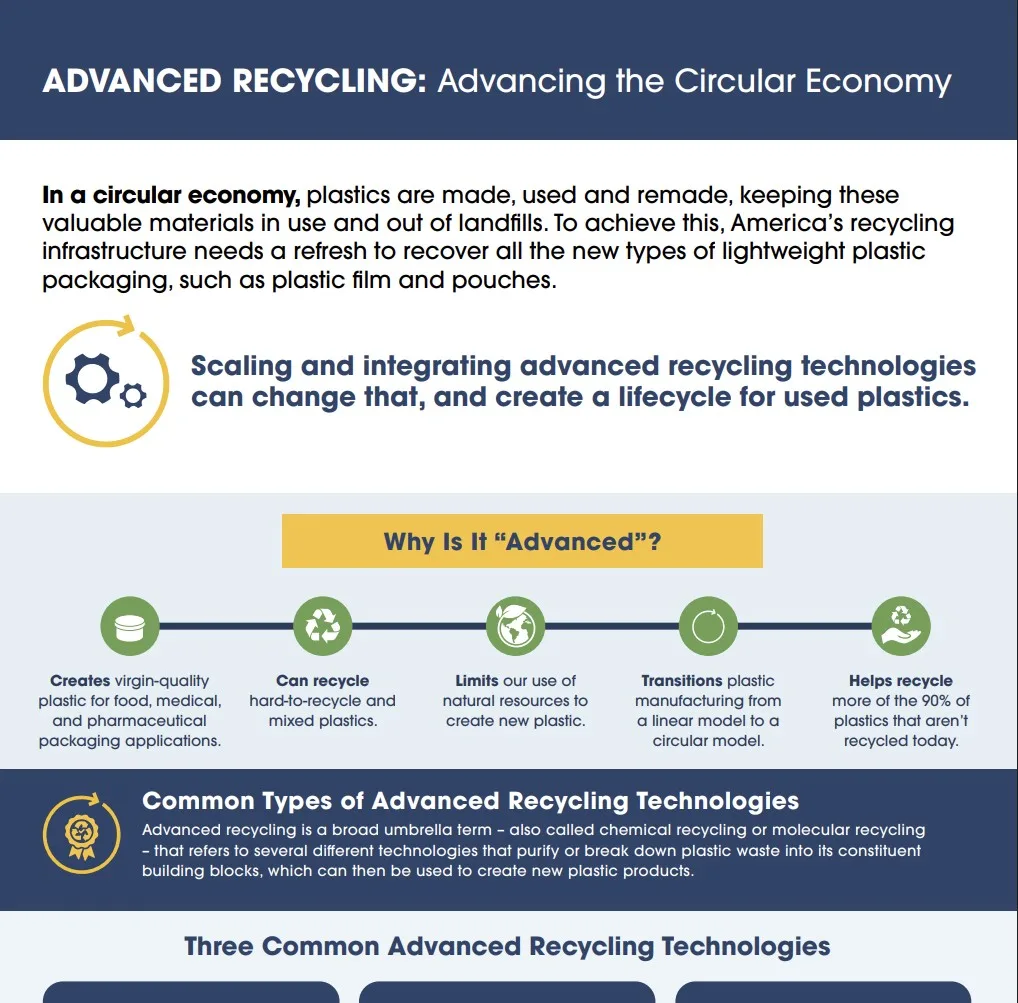
In a circular economy, plastics are made, used and remade, keeping these valuable materials in use and out of landfills. To achieve this, America’s recycling infrastructure needs a refresh to recover all the new types of lightweight plastic packaging, such as plastic film and pouches.
Scaling and integrating advanced recycling technologies can change that, and create a lifecycle for used plastics.
Why Is It “Advanced”?

Creates virgin-quality plastic for food, medical, and pharmaceutical packaging applications.
Can recycle hard-to-recycle and mixed plastics.

Limits our use of natural resources to create new plastic.

Transitions plastic manufacturing from a linear model to a circular model.
Helps recycle more of the 90% of plastics that aren’t recycled today.

Common Types of Advanced Recycling Technologies
Advanced recycling is a broad umbrella term – also called chemical recycling or molecular recycling – that refers to several different technologies that purify or break down plastic waste into its constituent building blocks, which can then be used to create new plastic products.
Three Common Advanced Recycling Technologies
Pyrolysis
Used plastics are heated in the absence of oxygen until thermally decomposed, then condensed into valuable materials.
Gasification
Used plastics are heated in an oxygen-controlled atmosphere and converted into syngas that is then converted into valuable materials.
Depolymerization
Used plastics are broken into smaller molecules (such as monomers) that can be used to make multiple valuable products. Includes solvolysis, methanolysis, and glycolysis technologies.
Advanced Recycling vs. Recovery
Years ago, technology providers sometimes converted hard-to-recycle plastics into fuel—classified as recovery, not recycling. Today, advanced recyclers are mostly focused on producing feedstock for high-quality plastics suitable for applications including medical, pharmaceutical and food packaging.
Advanced Recycling is Not Incineration
Incineration refers to destroying waste materials by burning.
During advanced recycling technologies such as pyrolysis, thermal energy (heat) is used in the absence of oxygen, so there is no combustion. This means plastics are not burned during advanced recycling.
Instead, plastics are broken down into their building blocks to form new feedstocks for plastics and chemicals, waxes and other products.
As a manufacturing process, there is a business incentive in advanced recycling to preserve every molecule to reuse.
Air Emissions
Like other manufacturing, advanced recycling facilities are subject to the Clean Air Act and state and local authorities. They also need to obtain operating permits and continue to monitor and report various air emissions as they operate.
A review of air emissions from advanced recycling facilities that use pyrolysis found emissions to be about equal to or lower than those from similar facilities such as hospitals and colleges. No measurable lead or dioxin emissions were identified. Advanced recycling facilities that use pyrolysis can operate efficiently under existing air quality regulations designed to protect the air we breathe.
WHO’S USING IT?
Many global brands have incorporated advanced or chemically recycled plastic into their products, building on historic use of “mechanically” recycled plastics.



water bottles




self care products


playsets


eyeglass frames