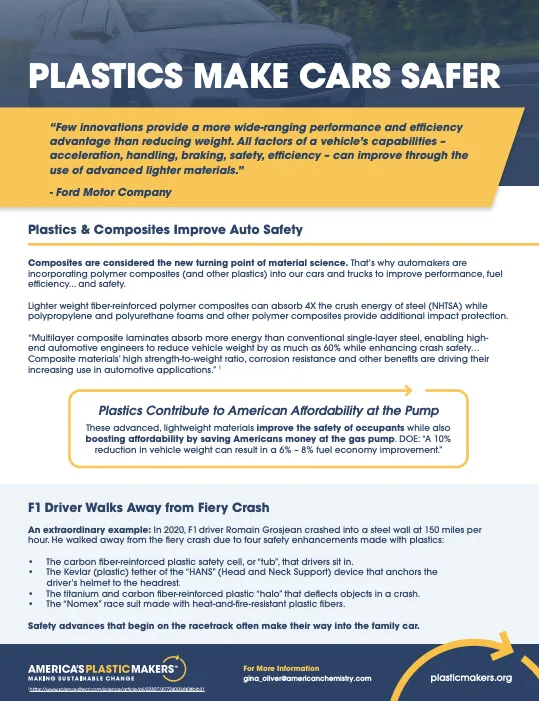
Plastics and composites improve automotive safety. Composites are considered the new turning point of material science. That’s why automakers are incorporating polymer composites (and other plastics) into our cars and trucks to improve performance, fuel efficiency… and safety.
Lighter weight fiber-reinforced polymer composites can absorb 4X the crush energy of steel (NHTSA) while polypropylene and polyurethane foams and other polymer composites provide additional impact protection.
Plastics Contribute to American Affordability at the Pump
These advanced, lightweight materials improve the safety of occupants while also boosting affordability by saving Americans money at the gas pump. DOE: “A 10% reduction in vehicle weight can result in a 6% – 8% fuel economy improvement.”
F1 Driver Walks Away from Fiery Crash
An extraordinary example: In 2020, F1 driver Romain Grosjean crashed into a steel wall at 150 miles per hour. He walked away from the fiery crash due to four safety enhancements made with plastics:
- The carbon fiber-reinforced plastic safety cell, or “tub”, that drivers sit in.
- The Kevlar (plastic) tether of the “HANS” (Head and Neck Support) device that anchors the driver’s helmet to the headrest.
- The titanium and carbon fiber-reinforced plastic “halo” that deflects objects in a crash.
- The “Nomex” race suit made with heat-and-fire-resistant plastic fibers.
Safety advances that begin on the racetrack often make their way into the family car.
Crash Tests Demonstrate Improved Safety in Modern Cars (Enabled by Plastics)
Crash test videos demonstrate the improved occupant safety in modern cars. In older steel-heavy cars, the crash dummy gets pummeled because the steel transfers the crash energy to the occupant. In new cars, plastic components absorb lots of crash energy to help protect the occupant. Contemporary cars are designed to take more of the beating from the crash instead of the occupant.
Auto Safety Advances Are Enabled by Plastics
- Seat belts: The use of seat belts (lap and shoulder belts) – which are typically made from polyester – reduces the risk of front seat passenger deaths by 45% in passenger cars. Seat belts saved nearly 15,000 lives in 2017 (NHTSA).
- Air bags: which are commonly made from high-strength nylon fabric – are credited with saving 50,457 lives in the period from 1987 to 2017 (NHTSA).
- Brake pads and linings.
- Energy absorbing bumpers.
- Crumple zones that help protect pedestrians and occupants.
- Safety glass (plastic film sandwiched by glass that helps prevent shattering and protects occupants in a crash).
- Foam dash boards, door panels and pillars.
- Fuel tanks (reduced fire risk).
- Housings, wiring and cables that prevent overheating.
- Backup cameras.
- Sensors for lane changing, blind-spots, antilock brakes, rain, tire pressure, parking assistance, adaptive cruise control and more that use radar and lidar.
- Windshield wipers (synthetic rubber or silicone = plastics).