U.S. states have set ambitious goals to reduce waste and increase the use of recycled and responsibly sourced materials across the economy. Mass balance is an accounting method that tracks how much sustainable material enters a system and ensures that no more than that amount is credited to finished products. Mass balance can help increase the use of recycled materials and support recycling goals.
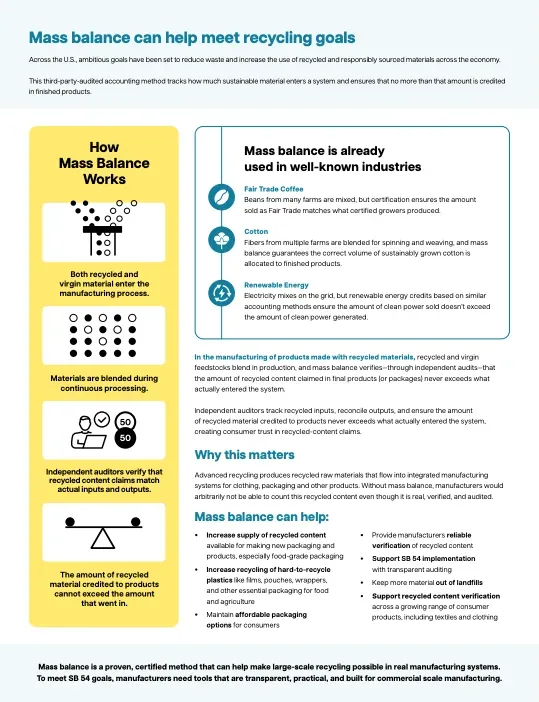
How Mass Balance Works
Mass balance accounting can be described, at a high level, as a four step process:
1

Materials enter the system.
Both recycled and virgin materials enter the manufacturing process.
2

Materials are blended.
Materials are blended during continuous processing.
3

Independent verification.
Independent auditors verify that recycled-content claims match actual inputs and outputs.
4

Recycled content is accurately accounted for.
The amount of recycled material credited to final products cannot exceed the amount that entered the system.

Independent auditors track recycled inputs, reconcile outputs, and ensure the amount of recycled material credited to products never exceeds what actually entered the system, creating consumer trust in recycled-content claims.
Similar Accounting Is Already Used in Familiar Industries and Products

Chocolate
Cocoa beans from many farms are mixed, but certification ensures the amount sold as Fair Trade matches what certified growers produced.

Cotton
Fibers from multiple farms are blended for spinning and weaving, and mass balance guarantees the correct volume of sustainably grown cotton is allocated to finished products.

Renewable Energy
Electricity mixes on the grid, but renewable energy credits based on similar accounting methods ensure the amount of clean power sold doesn’t exceed the amount of clean power generated.
Why Mass Balance Matters
Advanced recycling produces recycled raw materials for use in the manufacturing of clothing, packaging, and other products.
In many manufacturing of products made with recycled materials, recycled and virgin feedstocks blend in production, making it impractical to physically trace each recycled molecule into a specific finished product or package.
Mass balance provides a practical, transparent way to verify—through independent audits—that the amount of recycled content claimed in final products or packages never exceeds what actually entered the system through independent auditing.
Mass balance can help:
- Increase the supply of recycled content available for making new packaging and products, especially food-grade packaging.
- Increase recycling of hard-to-recycle plastics like films, pouches, wrappers, and other essential packaging for food and agriculture.
- Maintain affordable packaging options for consumers.
- Provide manufacturers reliable verification of recycled content.
- Keep more material out of landfills by supporting markets for recycled raw materials.
- Support recycled-content verification across a growing range of consumer products, including textiles and clothing.
Supporting Effective Recycling Policy
Mass balance offers policymakers a practical tool to support recycling goals and recycled-content policies while recognizing how modern manufacturing systems operate.
By allowing recycled materials to be verified and accounted for even when blended with virgin materials, mass balance can help support the use of recycled content at commercial scale.
Transparent accounting and independent auditing provide accountability, ensuring that recycled-content claims are supported by verified inputs and outputs.
Recognizing mass balance as a method for recycled-content accounting can help encourage investment in recycling technologies, expand markets for recycled materials, and support the development of a more circular economy.
A Practical Approach to Recycling at Scale
Mass balance is a proven, certified method that can help make large-scale recycling possible in real manufacturing systems.
Advancing recycling and recycled-content goals requires tools that are transparent, practical, and built for commercial-scale manufacturing. Mass balance provides a way to verify recycled content, support recycling markets, and help keep more material out of landfills.