

Plastic & Recycling Frequently Asked Questions
Your source for clear answers on plastics, recycling, innovation, and microplastics.
Your source for answers on plastics, recycling, innovation, and microplastics.
The story of plastics and sustainability can seem complicated. But it’s all based in chemistry and innovation. Let’s break it down with these commonsense explanations.
Plastic Basics
Plastics are lightweight, durable materials engineered from polymers. They’re made by linking small molecules (monomers) into long chains (polymers), producing versatile materials used in packaging, vehicles, medical devices, electronics, infrastructure, and more.
What’s the difference between virgin, recycled, and biobased plastics?
Virgin: produced from newly extracted feedstocks.
Recycled: produced from post-consumer or post-industrial plastics via mechanical or advanced recycling processes.
Biobased: made partly or wholly from renewable feedstocks; note that “biobased” ≠ “biodegradable.”
Biodegradable: breaks down via microorganisms over time (conditions vary).
Compostable: meets specific standards to biodegrade in controlled composting, leaving no toxic residue.
Recyclable: can be collected and reprocessed into new products.
They’re strong yet lightweight, design-flexible, efficient, and cost-effective—helping protect food, enable medical care, reduce shipping weight, and deliver energy-efficient products and infrastructure.
Do we need plastic?
The global community relies on plastics, which offer benefits related to clean drinking water to low-carbon energy.
Plastics contribute significantly to multiple United Nations Sustainable Development Goals:
- SDG 2: Zero Hunger – Plastic packaging helps reduce spoilage and food waste. The UN estimates a third of all food produced never reaches people.
- SDG 6: Clean Water and Sanitation – Modern, long-lasting plastic pipes can support new water infrastructure, improve its resiliency and cut energy use.
- SDG 7: Affordable and Clean Energy – Plastics are efficient materials that allow us to do more with less. The “strength-to-weight” ratio is why plastic is often relied upon for green technologies such as lightweighting vehicles and wind and solar energy infrastructure.
- SDG 13: Climate Action: Use of plastics in consumer products and packaging can reduce GHGs compared to many alternatives – research shows by about 2.5 times. One analysis found that in 13 of 14 cases plastics lowered greenhouse gas emissions compared to alternatives. That analysis demonstrated that in terms of both product lifecycle and use impact, GHG savings range from 10% to 90%.
- Lightweight plastics are used to decrease the weight of car parts, which reduces our fuel use and GHGs and increases the battery range of low-carbon EVs.
- Energy-saving plastic building materials can improve insulation performance (R-value) and help seal a building’s “envelope,” which saves energy and reduces GHGs.
Simply put, the global community cannot realistically meet its climate commitments without the help of plastics. However, to address plastic pollution, we need to accelerate a circular economy in which plastic products and packaging are sustainably reused or recycled instead of discarded, enabled by a global agreement that unlocks industry innovation and global investment in plastics circularity. The global plastic supply chain is taking concerted steps to move to a more circular ecosystem for plastics.
Can we cut down on plastic packaging?
Decades of life cycle analyses (LCAs) that study the environmental impacts of consumer goods have offered important insights on how plastics compare to other materials. Many of these studies have shown that:
- The use of plastic packaging and products can significantly reduce greenhouse gas emissions compared to alternatives such as steel, paper, aluminum, and glass.
- Replacing plastics with alternatives in many applications would significantly increase greenhouse gas emissions.
Using plastic often results in GHG benefits compared to alternatives primarily because it is strong yet lightweight, meaning plastic requires much less material to perform similar functions. (This is often called “source reduction.”) This impactful “strength-to-weight” ratio means plastic materials used in packaging and products are typically considered more efficient than alternative materials. How much more efficient?
This is why lightweight plastic packaging typically delivers more food and drink per pound and per unit than alternatives.
Recycling & Circular Economy
What is recycling?
Recycling involves collecting and processing materials that would otherwise be discarded and using them to make new products. The U.S. Environmental Protection Agency highlights recycling as a benefit to communities, the economy, and the environment. It recognizes that reusing and recycling materials conserves natural resources, reduces waste sent to landfills and incinerators, prevents pollution, reduces greenhouse gas emissions, and helps create jobs and tax revenue.
Given these benefits, the EPA set a “National Recycling Goal” to increase the national recycling rate for all materials to 50% by 2030. According to the Agency’s most recent data, in 2018 the national recycling rate was 36%.
Today, there is strong momentum to invest in and modernize the U.S. recycling system and develop a more “circular economy,” or a system where materials are collected and reused.
For plastics—as with paper, glass, aluminum, and steel—mechanical recycling is the most common method. It involves cleaning, cutting, melting and reforming materials. However, mechanical recycling is not well suited for all plastics. A newer set of technologies known as advanced recycling breaks plastics down at the molecular level and can help process more types of plastics than traditional methods.
What plastics can be recycled?
The EPA notes that one of the biggest challenges with recycling is knowing what can be recycled, since guidelines vary by location. Most communities accept plastic bottles, jugs, and containers labeled with recycling codes #1 (PET) and #2 (HDPE). Many areas also collect additional plastic containers and lids, including tubs and clamshell packaging.
Some plastics—such as flexible films, wrappers, and certain mixed materials—may be recyclable through advanced recycling technologies, but acceptance depends on local programs. Bags and wraps typically should not go in curbside bins and are better taken to store drop-off locations.
Because recycling is locally based and there is no federal standard, the best way to know what’s accepted in your community is to check your local government’s website for recycling guidelines.
The latest U.S. Plastic Recycling Study from Stina and the Association for Plastic Recyclers found more than 5 billion pounds of post-consumer plastic were recovered for recycling in 2022.
Why is the U.S. plastics recycling rate relatively low?
Several factors contribute: not all communities have curbside programs; many recycling facilities still lack the technology to handle today’s wide variety of plastics; and consumer participation is inconsistent. New technologies and infrastructure investments are helping to modernize and scale recycling nationwide.
Plastics aren’t captured as effectively as they could be. Some people are confused about how to recycle or do not have convenient recycling services. The “chop-and-wash” traditional processing technologies were not designed to deal with the complex and highly variable plastics in our waste streams today. About 83% of the plastic packaging that could be recycled curbside is not being put in the bin, according to The Recycling Partnership’s 2024 State of Recycling report.
Should we recycle plastic?
Yes. Recycling plastic helps keep valuable materials out of landfills and the environment, gives resources a second life, and reduces energy use and carbon emissions compared to making new plastic.
Recycling plastic can:
- Reduce the amount of plastic that ends up in landfills or as pollution.
- Reduce carbon emissions and save fossil resources.
- Give materials a second life in new products.
Today, most plastic in the U.S. is still not recovered—about 90% ends up in a landfill or is incinerated. Improving access to recycling and expanding public-private partnerships can help ensure more materials are captured and reused.
Mechanical recycling is a physical process (grinding, washing, separating, drying, re-granulating, compounding) that turns used plastic into reusable material (often pellets), effective for many bottles/containers but limited for complex items. Advanced recycling breaks plastics down at the molecular level, helping process mixed, layered, and soiled plastics and enabling like-new material for demanding uses.
What do advanced recycling technologies do, and why are they important?
Advanced recycling is a set of innovative manufacturing processes that use chemistry to transform the chemical structure of post-use plastics back to their basic chemical or molecular components. These technologies convert plastics that would otherwise be discarded into building blocks that can be remade into new plastics—including virgin-quality materials for food, medical, and pharmaceutical applications.
Unlike traditional mechanical recycling, advanced recycling can handle many plastics that are typically hard to recycle, such as films, multilayer packaging, and mixed plastics. By complementing mechanical recycling, it expands what can be recycled and increases the amount of recycled content available for use in new products.
Advanced recycling is important because it can help:
- Recycle hard-to-recycle plastics like films, layered packaging, and mixed materials.
- Recover more of the ~90% of plastics that aren’t recycled today.
- Transition plastic manufacturing from a linear to a circular model.
- Reduce the need for new natural resources to create plastics.
- Produce high-quality plastics suitable for sensitive applications like food and medicine.
Are most plastics downcycled?
In traditional, mechanical recycling, some types of plastic can degrade slightly each time they are recycled. In some cases, they can’t be recycled more than once or twice. However, even in these instances, plastic may find opportunity for a new life in a different product – often a durable product that has a longer lifespan for use. Milk jugs can be turned into clothing, furniture, or even speakers, for example. While this can be referred to as “downcycling,” a more appropriate term that is used is “open-loop recycling,” which just means a product has found value as something new – while keeping it out of the landfill.
Open-loop recycling can help keep materials in use, reduce consumption of raw materials, and avoid the energy use and greenhouse gas emissions associated with resource extraction and production.
Turning plastic bottles into fleece or carpet fiber and converting paper into paper towels, tissue paper, or egg cartons are examples of open-loop recycling.
Additionally, plastic bags and wraps may go on to become durable, low maintenance lumber for your backyard deck or fence. One of the largest recyclers of plastic bags is Trex – a 500-square foot composite Trex deck contains about 140,000 recycled plastic bags!
How does plastic get recycled?
Recycling is a complex system. To recycle plastic, an interwoven chain of players must work in concert. The plastic recycling chain can be viewed as a virtuous circle in which each player enables another.
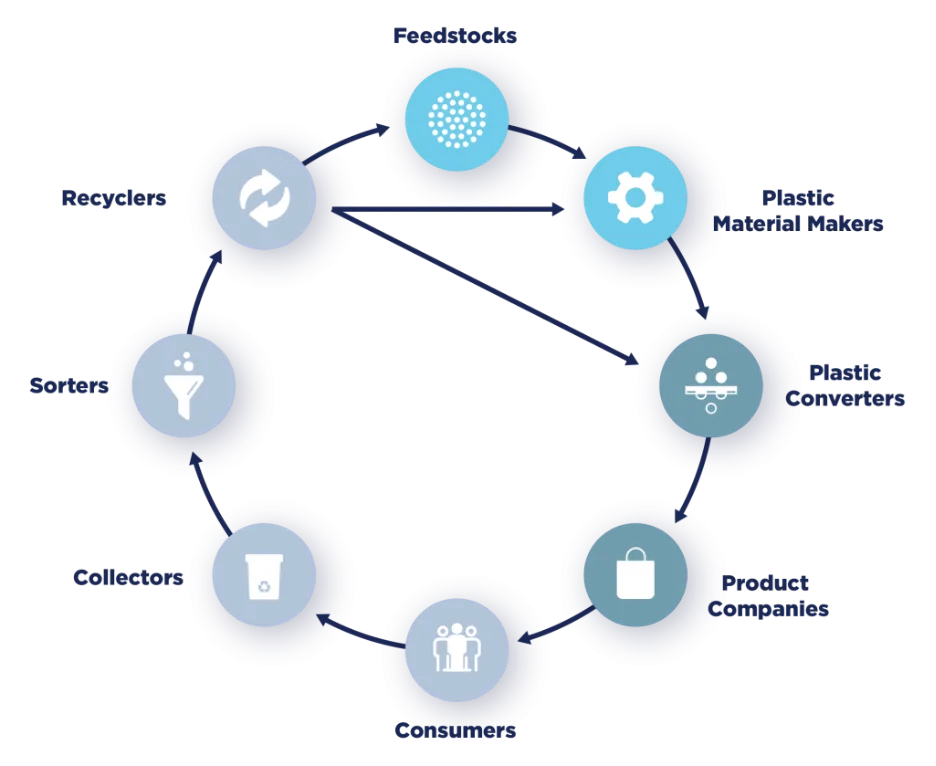
As the diagram indicates:
- Raw materials companies provide “feedstocks” to make plastic.
- Plastic makers manufacture plastic materials.
- Plastic converters use plastic materials to make packaging and products.
- Product companies sell products (in packaging) to consumers.
- Consumers deposit recyclable products and packaging in recycling bins.
- Sorters separate various plastics from each other and other materials.
- Collectors pick up recyclables from consumers.
There is no start or finish to the plastic recycling chain. All players must play their part to successfully recycle plastic.
Innovations to strengthen recycling are increasing, with more effective sorting technologies – including artificial intelligence, robotics, and near-infrared optics – being introduced to enable more post-use plastics to be recycled.
The recycling rate is the amount of post-use materials recycled as a percentage of the total generated, generally measured by the U.S. Environmental Protection Agency, though other third-party organizations also gather this data for specific materials. The EPA hasn’t calculated recycling rates since 2018, so the latest available EPA figure is from that year, along with the 2022 U.S. Post-consumer Plastic Recycling Study from the Association of Plastic Recyclers.
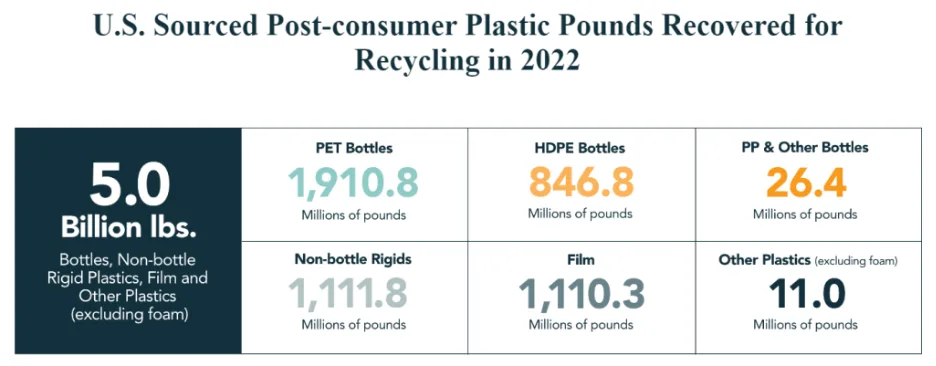
(Source: Association of Plastic Recyclers)
The U.S. has collected about 5 billion pounds of plastics annually from homes for more than a decade, but we have the capacity to recycle much more. Increasing recycling will require better education and greater participation.
The recycling rate for plastic packaging is around 13%, and much of it is not collected for recycling because today’s system was not designed to process many of the packaging types used today.
There are efforts in the U.S. to modernize recycling infrastructure (more domestic processing, better sortation) and educate consumers about what can be recycled, aligning with EPA’s National Recycling Goal/Strategy and leveraging market demand for recycled content to drive investment.
What is needed to improve plastic packaging recycling rates?
We’re throwing valuable material away every day. Why is this happening?
- Plastics aren’t captured as effectively as they could be. People are confused about how to recycle or do not have convenient recycling services at home, work, or school. These barriers translate into low capture and high contamination rates. For example, a Recycling Partnership study found only 73% of households in America have access to recycling and only 43% of households participate in recycling.
The “chop-and-wash” traditional processing technologies used for the past few decades were not designed to deal with the complex and highly variable plastics in our waste streams today. Mechanical recycling works well for certain plastic packaging but is limited in its ability to sort and process films and labels, chip bags, synthetic fibers, and other “mixed plastics.”
But progress is being made. Many companies are working to make their plastic packaging easier to recycle. Large brands are demanding more plastic containing recycled content to meet sustainability goals. So, many of today’s plastic makers are creating some of their products with recycled plastic and announcing plans for more. These trends support a self-reinforcing loop: easier-to-recycle packaging, more market demand for recycled plastic, and more recycled plastic.
Brands need more recycled content in plastics to meet sustainability goals and state recycled content laws. These trends can support a self-reinforcing loop: easier-to-recycle packaging, more market demand for recycled plastic, and more recycled plastic.
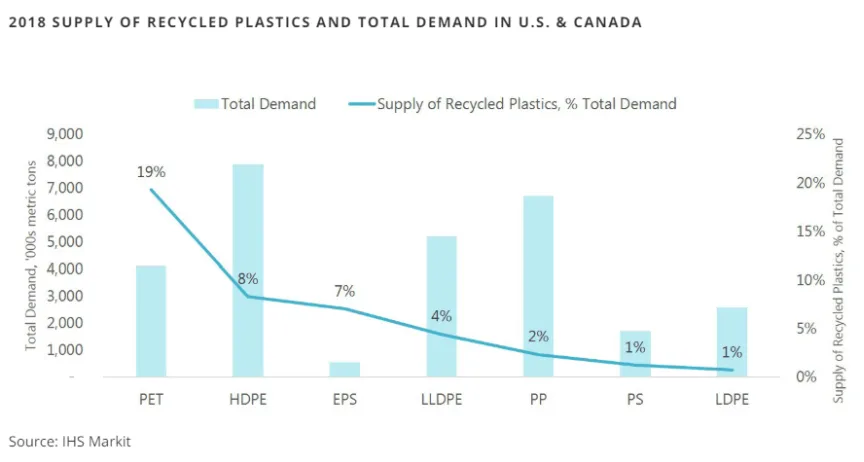
Why do we need recycled content? (Is there demand for recycled plastics?)
Many of the world’s largest consumer brands and retailers, including Coca-Cola, Danone, Nestle, PepsiCo, Unilever, Walmart, and others have made public commitments to use more recycled plastics in their packaging, signaling the market opportunity to invest in more circular solutions. Their actions can keep more plastics out of landfills and in use, while reducing our reliance on virgin fossil resources. Continued innovations and investments in our recycling systems and infrastructure can help us meet that demand.
In addition to market shifts, state policies are also helping to increase demand for recycled plastics. Washington State and New Jersey, for example, have enacted minimum recycled content requirements for certain non-beverage bottle plastic packaging. Additionally, states that have enacted packaging extended producer responsibility (EPR) and other laws are expected to drive increased use of recycled material. For example, in Oregon, EPR fees must consider the recycled content of a covered item.
- Demand for recycled plastic is strong and growing, but the current supply – estimated at about 6% of demand – is limited by recycling infrastructure and household collection rates.
How can we address the plastic waste challenge?
The media often focuses the “plastic waste” conversation on single-use plastics. However, two-thirds of plastics in the U.S. come from non-packaging sources, and the current mechanical recycling system isn’t equipped to handle them effectively. Fortunately, advanced recycling technologies are emerging, enabling the recycling of many textiles, healthcare wastes, and various durable goods. This category, known as “bulky rigids,” includes items such as appliances, building materials, and automobile parts. It is essential that we stop thinking of plastic as waste and start treating it as a resource.
Many large brands are committing to use more recycled plastics, increasing demand for recycled material. But supplies remain limited due to gaps in collection and recycling infrastructure. Addressing this challenge will require scaling technologies that keep plastics in play and expanding investments in collection, sortation, and recycling. These solutions can also help decrease reliance on fossil resources, lower landfill disposal costs for municipalities, and reduce marine pollution.
Yes. A circular system where materials are collected and reused is possible with mechanical and advanced recycling as complementary technologies to keep plastics in use.
How do recycling innovations benefit the economy?
Modernizing recycling creates U.S. jobs, attracts private investment, and strengthens domestic manufacturing by providing reliable supplies of recycled materials.
How can policymakers support recycling innovation?
By passing bipartisan legislation—such as the STEWARD Act, the Recycling Infrastructure Advancement Act, the Recycling and Composting Accountability Act —policymakers can help modernize infrastructure, expand mechanical and advanced recycling, and create a steady stream of recycled plastic for U.S. manufacturers.
What is PCR? What is post-industrial plastic?
PCR stands for “post-consumer recycled” or sometimes the product is known as “post-consumer resin” when referring to recycled plastic.
A broader term, “post-use plastic,” is sometimes used and refers to materials entering the recycling stream from residential, municipal, industrial, community, or commercial sources.
Post-industrial, also referred to sometimes as “pre-consumer plastic recovered material,” is material that has never reached the end user, having been diverted from the waste stream during a manufacturing process. An example of this that is used in the advanced recycling stream is the trimming from the making of diapers.
Post-industrial plastics, as well as medical waste, are not calculated in EPA’s recycling rates or in the Post-Consumer Plastic Recycling Study.
What is a MRF?
A MRF (pronounced “merf”) is a commonly used acronym for a “materials recovery facility.” A MRF is a facility that receives the mixed items people put into recycling bins and separates them into single streams of like materials to be sold to buyers. This process is referred to as sortation. And while it has traditionally been a manual job, new technologies such as robotics, optical scanners, and AI are making it much more efficient and can create higher yields.
The materials that can’t be “baled” for sale sometimes go through a secondary sortation that pulls out items that can be sold to other industries, including advanced recycling operations. A small percentage of materials gets landfilled if there is no “end market” for them, usually the result of people “wishcycling,” meaning putting things in the recycling bin that cannot be recycled.
Unfortunately, incorrect items can end up contaminating good recyclables and can potentially damage the equipment in recycling facilities and reduce recovery rates — and, in some cases, cause harm to employees.
How Food-Contact Plastics Are Regulated for Safety
Which plastics are safe for food contact?
There are innumerable types of plastic, but only plastics that have been evaluated and authorized by the U.S. Food and Drug Administration (FDA) for food-contact uses can be used to package, store, transport, and protect food and beverages. FDA requirements vary based on the specific plastic, its intended use, and how it may come into contact with food.
What does “food-grade” or “food-contact” plastic actually mean?
“Food-grade” or “food-contact” typically refers to substances that are regulated by the FDA as “food-contact substances” (FCSs). According to FDA, FCSs include packaging materials and items that may reasonably be expected to come into contact with food during manufacturing, transport, storage or use.
For example, FCSs include plastics and additives used in food processing equipment, food preparation surfaces, cutting boards, cookware, bottles and packaging (including pet food packaging).
How does the FDA decide a food-contact plastic is safe before it can be sold?
Before a food-contact plastic can be used, sold or marketed in the U.S., the FDA generally requires scientific data demonstrating its safety for its intended use. That review process can include evaluating:
- The type of food (9 different categories, including beverages) the packaging will contact
- How long the food and packaging interact
- Whether the packaging will be exposed to heat, cold or sunlight
- Whether small amounts of the substance could migrate from packaging into food
- Estimated dietary exposure, if any, as a result of migration
- Whether or not the packaging will be refilled
- Toxicology and safety data
Is plastic food packaging tested under real conditions?
Food-contact plastics are evaluated for their intended use. For example, FDA evaluates data from testing under real-world conditions that take into account the type of food being packaged (beverages, wet or dry foods, acidic or fatty foods) and the intended use of the packaging (refilled, frozen, boiled, microwaved). In addition, testing often exaggerates real-world conditions, which can add an extra safety buffer.
Can chemicals migrate (or “leach”) from plastic into food?
Substances used to make food packaging of any type (plastic, metals, paper, etc.) have the potential to migrate into food. To confirm that levels likely to migrate are below safety thresholds set by the FDA, food-contact substances undergo significant testing under real-world conditions for the intended use. If FDA identifies a significant safety concern, the agency can object to the proposed use of that packaging material and prevent its entry into the market.
How can I tell if a container is “food-grade”?
Substances (including materials) used to package food in the U.S. must undergo FDA review. So, if the container or package contains food when purchased, it is food-grade.
However, there is no labeling requirement for food-grade plastics in the United States. Some containers carry a goblet and fork symbol or labeling that identifies the container as food-grade or food-safe, and some may indicate they are not food-safe. However, lack of labeling does not indicate a lack of safety.
Consumers can also contact the container and/or food manufacturer directly for confirmation.
Is it safe to microwave food in plastic containers?
Food-contact plastics are evaluated for their intended use, such as microwaving. During testing:
- A frozen microwavable meal is both frozen and microwaved to make sure that substances do not migrate from the packaging at levels deemed unsafe.
- Packaging intended for microwaving is heated above boiling to 266 degrees F for 15 minutes to measure potential substance migration.
Additionally, the manufacturer must indicate any use limitations on the packaging. Always be sure to follow the manufacturer’s instructions.
Avoid microwaving in a plastic container unless the package specifically indicates you can. Unless the container or package was designed to withstand microwave conditions, it could lose its integrity during heating and cause hot spills or burns
Does plastic food packaging release microplastics into food?
While the release of microparticles from multiple packaging materials is likely inevitable during food manufacture, distribution and use, the FDA has found that:
“Current scientific evidence does not demonstrate that levels of microplastics detected in foods pose a risk to human health.”
Current evidence suggests food packaging releases far fewer microplastics than many publications have reported, according to the European Food Safety Authority (EFSA). The governmental health authority reached that conclusion after identifying more than 1,700 microplastics studies from 2015 to 2025, noting microplastic release is due to mechanical stress, such as abrasion or friction. Learn more.
Does food packaging actually reduce enough waste to justify the plastic?
Plastic packaging has been proven highly effective at protecting food and extending its shelf life. When food spoils, it costs people money and negatively impacts the environment.
Additionally, multiple studies have found that plastic packaging typically has lower lifecycle greenhouse gas emissions and creates less waste compared to alternatives such as metal, glass and paper. This is largely because plastics require far less material to package food than alternatives.
In many applications, a small amount of plastic packaging can help prevent significant environmental impacts from heavier packaging and/or food waste.
Microplastics
Microplastics are tiny plastic particles—typically less than 5 millimeters in size—that can result from the breakdown of larger plastic products over time or be intentionally added to products for specific functions. They can form through wear, use, and improper disposal, which is why reducing waste and improving recovery systems is critical.
Learn more about Microplastics.
The main sources of microplastics are tire wear particles, synthetic fibers from textiles, degradation of unmanaged waste, and flaking paint from roads and buildings. Tire wear and synthetic fibers from textiles are thought to be the largest contributors of microplastics entering the environment.
Our industry is investing in innovations that reduce the potential for plastics to enter the environment. Designing products for reuse and recyclability, expanding recycling infrastructure, and supporting cutting-edge research are priorities. We are collaborating with scientists, governments, and businesses to unlock targeted, science-based solutions.
Innovations in product design and recycling technologies are making it easier to reuse plastics. Advanced recycling technologies also help conserve natural resources and reduce the environmental footprint of plastic.
Is the plastics industry investing in scientific research on microplastics?
Yes. Globally, our industry has supported over 100 researchers across 37 institutions to advance the science on microplastics. Through the Microplastics Advanced Research and Innovation Initiative (MARII) platform, we facilitate global collaboration to enhance research quality and consistency.
To date, leading health authorities—including the FDA and WHO—have found that while the current scientific data is of poor quality, the current weight of evidence does not show microplastics pose a risk to human health. Science and innovation, not speculation, should guide how we address this complex issue.
We support science-based policies that target solutions based on a real assessment of risks, encourage innovation, foster public-private partnerships, provide regulatory certainty, recognize distinctions between intentionally added and unintentionally generated microplastics, and oppose fragmented or symbolic policies.
We believe blanket bans or symbolic caps often miss the mark. Instead, we support targeted, fact-based interventions—like improved wastewater treatment and enhanced recycling systems.
Innovation & Benefits
How are innovations in packaging and product design improving recycling?
Design-for-recycling strategies (fewer materials, clear labels, compatible layers) make recovery and reprocessing plastics easier.
How do plastics help reduce food waste and improve sustainability?
By protecting food in transit and extending shelf life, plastics help curb food waste—a major driver of GHG emissions—while reducing breakage and spoilage.
How does use of plastics contribute to lower greenhouse gas emissions compared to other materials?
Multiple life-cycle assessments have found that the use of plastics typically requires less energy and generates fewer GHGs than alternatives in comparable uses, due to strength-to-weight and performance attributes.
What role do plastics play in lower carbon technologies like EVs, and renewable energy?
Plastics enable lighter EV components for a longer lasting battery charge, plus more efficient renewable energy systems (e.g., wind/solar).
Policy & Stewardship
What policies could improve plastics recycling in the U.S.?
EPA’s National Recycling Goal/Strategy and market-pull policies (e.g., recycled content standards), extended producer responsibility (EPR) frameworks, and investment incentives can modernize collection, sortation, and end-markets.
How do recycled content laws work?
By encouraging the use of recycled content, such laws are meant to increase demand for recycled feedstock and supports investment in collection and processing.
What is extended producer responsibility (EPR) and how does it affect plastics?
EPR is a policy framework that assigns producers a funding and management role in collection and recycling systems, aligning design decisions with end-of-life outcomes and improving program consistency.
For all materials, including plastics, EPR can help drive higher recycling rates and help ensure more packaging and products are collected, sorted, and reprocessed into new materials. When designed well, EPR programs can support investment in modern recycling infrastructure, incentivize the use of recycled content, and encourage innovation in packaging design to improve recyclability and reduce waste. Poorly designed EPR systems, however, can increase costs for consumers and manufacturers without delivering meaningful environmental benefits.
Why is it important to regulate advanced recycling technologies as manufacturing?
Advanced recycling facilities purchase cleaned, sorted plastic that would otherwise be discarded to use as a feedstock to create chemical building blocks that can be used to make new products – the basics of what manufacturing is. Treating advanced recycling as manufacturing appropriately regulates the technology and encourages investment and innovation that expands U.S. recycling and manufacturing capacity.
Public Engagement
What can individuals do to recycle more and reduce plastic waste?
Start by checking your local recycling guidelines for what’s accepted in your community (rules vary). Rinse containers, keep caps on bottles, and take bags/wraps to store drop-off where available
What is Operation Clean Sweep® and how does it help safeguard against resin loss?
Operation Clean Sweep® (OCS) is an industry-led program that supports companies in their efforts towards eliminating plastic resin (pellet, flake, powder, and granule) loss in operations to: preserve water quality, protect the environment, and strengthen worker safety. OCS was founded by Plastics Industry Association (PLASTICS) in 1991 and is managed in partnership with the American Chemistry Council (ACC)’s Plastics Division.
Why should the public trust industry-led initiatives like Operation Clean Sweep?
Operation Clean Sweep goes beyond voluntary guidance—it now includes mandatory quarterly data reporting and third-party inspections for OCS Blue and OCS Logistics members in the U.S., bringing together producers, shippers, and converters to prevent plastic resin loss at every step.