A recent article in The Wall Street Journal highlighted how artificial intelligence and automation are solving the recycling industry’s labor gap by taking on the repetitive task of sorting recyclables. As the article notes, machines are helping to more efficiently and effectively recover valuable commodities.
But better eyes on the sorting line are only half the battle. Once we sort these materials, we need a system capable of processing them.
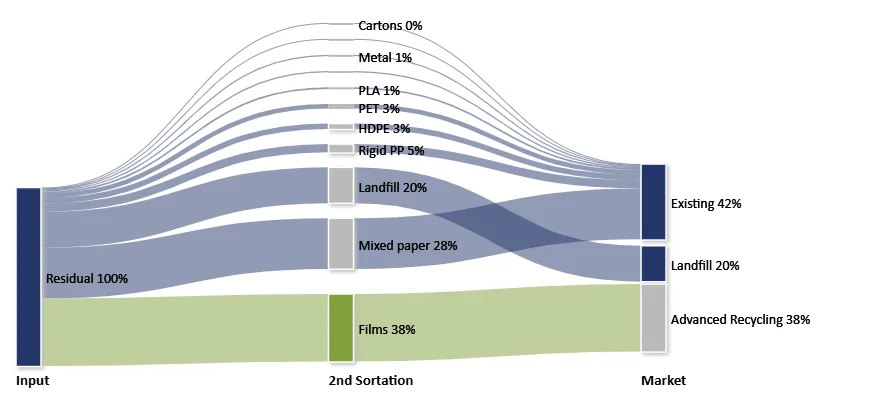
Policy should not get stuck with a “false choice,” like pitting different recycling technologies—mechanical and advanced recycling— against each other. A recent pilot project in the Great Lakes region shows that the solution isn’t ”either/or”—it’s mechanical AND advanced recycling, working together to recover up to 80% of residual material leaving recycling facilities otherwise destined for landfills.
For plastics, after collection and sortation, mechanical recycling uses a physical process to turn used plastics into a raw material, where advanced recycling typically uses heat.
To unlock this potential, we need policy that promotes innovation and embraces technology neutrality.
The Hardware: Secondary Sortation for Recycling
To understand the power of “And,” we first must look at the hardware: Secondary Sortation.
The sorting equipment currently in place is primarily designed for “3D” objects like bottles and cans. It struggles to distinguish ”2D” flexible packaging—chip bags, pouches, and films. These items often get misrouted, ending up as “residual” waste bound for the landfill.
Secondary sortation creates a safety net: It aggregates these residuals and re-sorts them through a specialized facility that often includes augers and optical sorters to capture additional recyclables—especially flexible plastic packaging.
Why We Need Both Technologies
Here is why the “false choice” narrative fails: secondary sortation creates two very different streams of recovered material.
The Great Lakes pilot recovered 80% of residual waste leaving recycling facilities broke down into two distinct categories:
- 42% of the material (like paper and PET bottles) had existing mechanical markets.
- 38% consisted of films and mixed plastics.
Mechanical recycling is the workhorse for the first group. It is efficient and established. But it cannot process that second group of complex plastics.
Advanced recycling (like pyrolysis) complements mechanical recycling by handling those complex films and multi-layer packages. It breaks them down to their molecular building blocks, creating virgin-quality feedstock suitable for sensitive applications like medical and food-grade packaging.
Data shows that advanced recycling creates a market for ~40% of the material stream would otherwise be landfilled.
The Policy Challenge: Enabling the “And”
The technology to recover these materials exists. The economic case for building a resilient domestic supply chain is clear. But, the “And” only works if policy allows it.
Including unachievable targets, adverse technical language targeting a technology doesn’t help, it makes it more difficult to recycle. In the Great Lakes pilot, bias policies would result in 38% of recovered mixed plastic landfilled.
We need technology-neutral policy that focuses on outcomes, not methods:
- Outcome-based: Create a data-informed process to set recycling and recycled content goals.
- Certification: Recognize standards and certification that boost transparency and confidence in the system.
- Support Resilience: Prioritize attracting investment into innovation and recognize that mining our waste stream for raw materials strengthens domestic manufacturing.
Choose the Power of “And”
We are on the cusp of a breakthrough. AI helps us see our waste with unprecedented clarity. Advanced recycling is giving us the tools to recover materials we once thought unrecoverable.
Technology cannot overcome restrictive policy. To take advantage of these innovations, we need policymakers to embrace pragmatism. We need rules that focus on the destination—a circular economy—without dictating the vehicle we use to get there.
It’s time to stop choosing between technologies and start using the power of “And.”